
This page shows all events ABCP (co-)organised and will be (co-)organising. Some events (co-)sponsored or supported by ABCP may also be included.

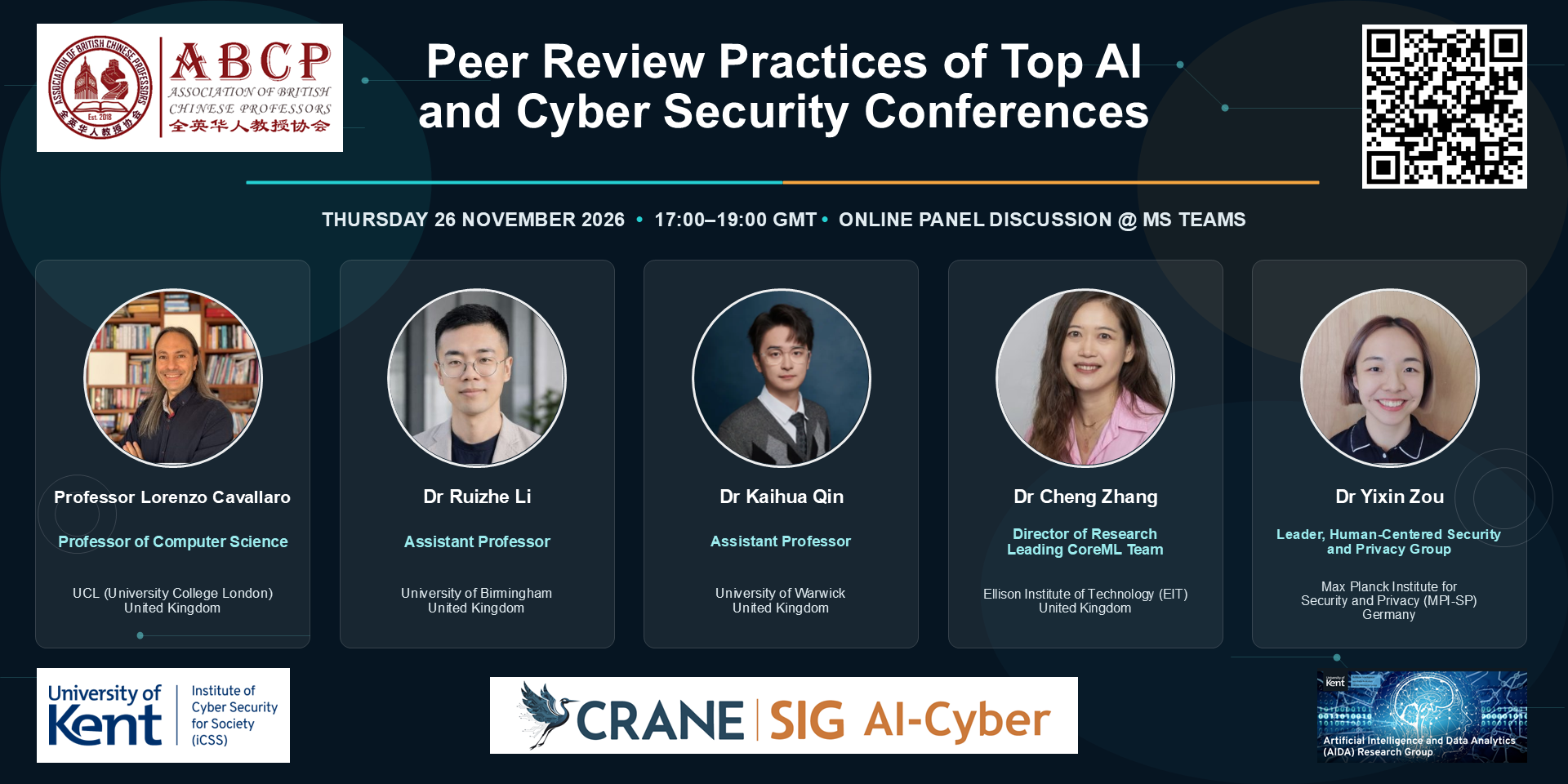
Peer Review Practices of Top AI and Cyber Security Conferences
How to participate?
Online on MS Teams:
https://teams.microsoft.com/meet/372521797829137?p=1OtsoPAM2C7Gr9Klvj
Meeting ID: 372 521 797 829 137
Passcode: Zh27DS98
Introduction
ABCP’s Specialty Committee on AI and Cyber Security is organising an online panel discussion on the current peer review practices of top AI and cyber security conferences and how such practices will evolve in the future, considering the exponentially increasing number of paper submissions (e.g., ICLR 2027 received over 60k submissions).
The following five AI and/cyber security researchers will join the panel discussion. They have served on the PCs (Program Committees) of many top AI and cyber security conferences, and three of them also had experiences or will have experience on co-chairing PCs or a track of such conferences.
- Professor Lorenzo Cavallaro, Professor of Computer Science, UCL (University College London), UK (ACM CCS 2027 and 2028 PC Co-Chair)
- Dr Ruizhe Li, Assistant Professor, University of Birmingham, UK (regular Area Chair of NeurIPS, ICLR, ACL, EMNLP, IJCAI, NAACL and CIKM)
- Dr Kaihua Qin, Assistant Professor, University of Warwick, UK (regular PC member of all top four cyber security conferences – IEEE S&P, ACM CCS, USENIX Security, and NDSS)
- Dr Cheng Zhang, Director of Research leading CoreML team, Ellison Institute of Technology (EIT), UK (NeurIPS 2024 PC Co-Chair; NeurIPS 2025 General Chair; current member of NeurIPS Board)
- Dr Yixin Zou, Leader of Human-Centered Security and Privacy group, Max Planck Institute for Security and Privacy (MPI-SP), Germany (PETS/PoPETs 2026 and 2027 Vice Program Chair/Associate Editors-in-Chief; ACM CCS 2025 Co-Chair of “Usability and Measurements” Track)
The panel discussion will be facilitated by Professor Shujun Li, Professor of Cyber Security at the University of Kent (part of London and South East University Group). Professor Li is also a Co-Chair of ABCP’s Specialty Committee on AI and Cyber Security and ABCP’s VP for IT & Governance.
The event is open to all. The working language will be English.
The panel discussion is co-organised and technically sponsored by the Institute of Cyber Security for Society (iCSS) and the Artificial Intelligence and Data Analytics (AIDA) Research Group at the University of Kent (part of London and South East University Group), and by the AI-Cyber SIG of CRANE, an EPSRC-funded NetworkPlus for strengthening the UK’s cyber security research ecosystem.
 |
 |
 |
Bios of Panellists
Professor Lorenzo Cavallaro grew up on pizza, spaghetti, and Phrack, and soon developed a passion for underground and academic research. He is a Full Professor of Computer Science at University College London (UCL), where he leads the Systems Security Research Lab (S2Lab). His work is driven by a simple question: how do we make AI reason in a way we can trust? His research explores the foundations of trustworthy AI for systems security, focusing on semantics-grounded representations, program analysis, and uncertainty-aware reasoning in adversarial settings. The goal is not just to improve models, but to build a principled science of (code) reasoning. He publishes regularly at leading venues in computer security and machine learning, received a Distinguished Paper Award at USENIX Security 2022, an ICML Spotlight 2024, serves the community through program committees and editorial roles, and is Program Co-Chair of ACM CCS 2027 and 2028. He is also co-founder and Chief Scientific Officer of BynarIO, where these ideas are translated into practice to autonomously identify, prioritize, and repair vulnerabilities in real-world software, restoring trust and control over what we run. In addition to his love for food, he finds his Flow in science, music, and family.

Professor Lorenzo Cavallaro
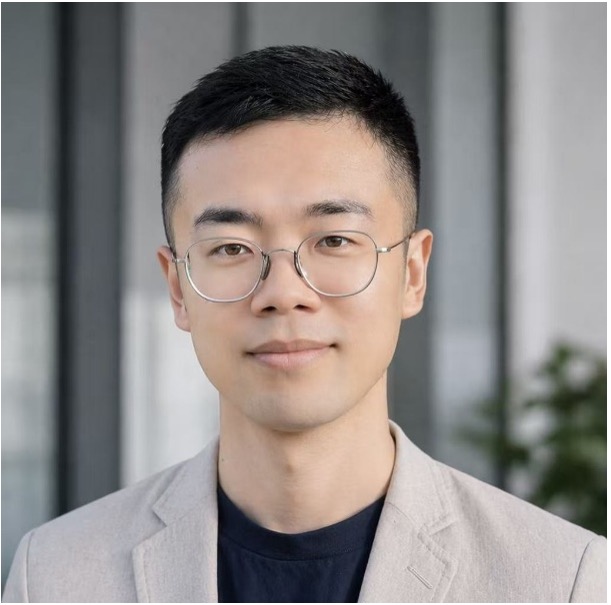
Dr Ruizhe Li is an Assistant Professor at the School of Computer Science, University of Birmingham. He was a postdoctoral research fellow in the Web Intelligence Group, affiliated with the Centre for Artificial Intelligence at UCL. He received his PhD from the Sheffield NLP group, the Department of Computer Science at University of Sheffield. Ruizhe’s research interests focus on AI safety, interpretability of LLMs and Multimodality LLMs by understanding LLMs internal working mechanism, improving LLMs safety internally across different domains, and applying to multimodality LLMs downstream tasks as well. He has consistently published on different top-tier AI, machine learning and NLP conferences, such as ACL, IJCAI, ICML, ICLR, EMNLP, AAAI. He serves as the Area Chair of NeurIPS, ICLR, ACL, EMNLP, IJCAI, NAACL, CIKM, etc. He was awarded INLG 2019 Best paper runner-up, Area Chair Award of ACL 2023, Best Paper Award of COLM 2025 XLLM-Reason-Plan Workshop, Best reviewers of EMNLP 2020 and 2024 and Gold Reviewer of ICML 2026. His research is supported by Google, Cohere, Thinking Machines Lab and The Royal Society.
Dr Ruizhe Li
Dr Kaihua Qin is an Assistant Professor of Computer Science at the University of Warwick. His research focuses on understanding and tackling security challenges in emerging computational systems, particularly blockchain and DeFi systems, as well as AI-driven and agentic systems. His work has appeared at leading venues including IEEE S&P, USENIX Security, ACM CCS, and NeurIPS. He has extensive peer-review experience, serving on the program committees of top security conferences including ACM CCS, IEEE S&P, USENIX Security, and NDSS.

Dr Kaihua Qin
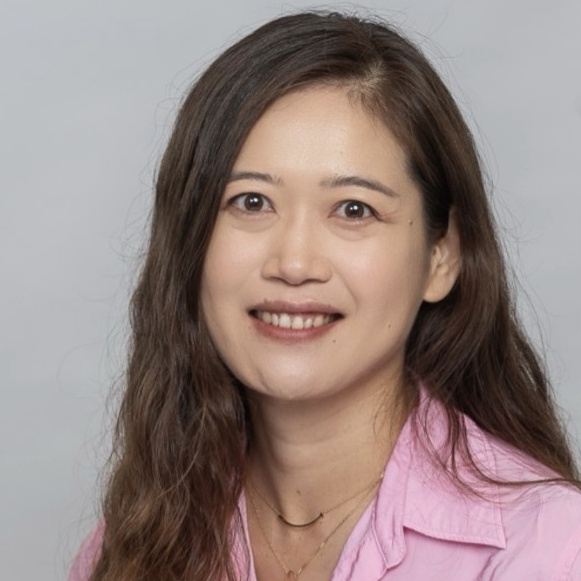
Dr Cheng Zhang is a Director of Research at the Ellison Institute of Technology (EIT), where she leads AI research to accelerate scientific workflows through autonomous laboratories (AutoLabs). She currently leads a team developing multimodal foundation models, including vision-language-action (VLA) models and world models. She has over a decade of experience in generative AI and machine learning, spanning cutting-edge research and the translation of research into real-world products through collaboration with cross-functional teams. Before joining EIT, Dr Zhang served as a Research Manager in Meta’s Superintelligence Lab (formerly the GenAI/LLaMA team), leading the EMEA team on reasoning and agent research. Prior to that, she held Technical Lead Research Manager role at Microsoft Research Cambridge for over 6.5 years and conducted research at Disney Research, Carnegie Mellon University, before that. Throughout her career, Dr Zhang has driven high-impact projects that bring scientific research innovations to real-world applications. She and her teams have delivered cutting-edge work in reasoning and agentic systems with foundation models (contributing to Llama 3.3 and Llama 4) deep generative modeling, causal machine learning, and probabilistic modeling in prior work. Her research on causally aware deep learning led to a program allocation system at Microsoft that tripled marketing efficiency in scaled managed partners, and she advanced AI-driven personalized education technologies reaching more than half of UK schools through third-party collaborations. Dr Zhang is also an active contributor in the global AI research community, serving as Program Chair for NeurIPS 2024, General Chair for NeurIPS 2025, and a current member of the NeurIPS Board.
Dr Cheng Zhang
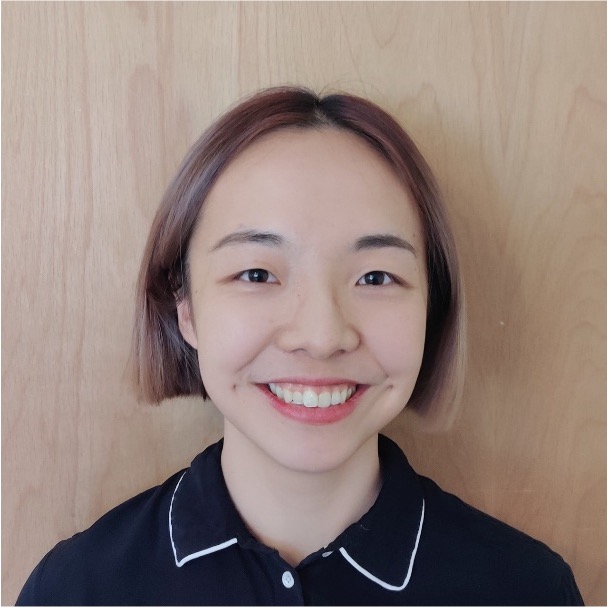
Dr Yixin Zou is a tenure-track faculty member at the Max Planck Institute for Security and Privacy in Bochum, Germany, where she leads the Human-Centered Security and Privacy group. Her research seeks to make security, privacy, and AI technologies safer and more equitable for everyone, especially marginalized and underserved communities. She regularly publishes at leading venues in computer security and human-computer interaction. She is a vice program chair for PETS 2026 and 2027 and a regular program committee member for CHI and SOUPS, and she previously served as a co-chair of the Usability and Measurements track at ACM CCS 2025. She earned a Ph.D. in Information from the University of Michigan in 2022.
Dr Yixin Zou